
Zenoh 1.10.x Mucalinda has landed!
Mucalinda is the guardian Nāga who, as the story goes, rose during a great storm to coil around the meditating Buddha and shield him beneath his hood. A fitting name for a chapter shaped by changing tides, and a quiet reminder that what truly matters can always find guardians willing to stand watch over it.
This release concentrates on the paths data actually travels: how fast bytes come off the wire, how much you can see about where the time goes, and how little ceremony it takes to reach Zenoh from your language of choice. On Linux, an optional io_uring receive backend shortens round-trip latency on eligible unicast links. A new timestamp stack lets a message record where it has been, turning end-to-end latency from a single number into a per-hop breakdown. And the JVM bindings were rebuilt on generated JNI code, more than doubling throughput on small samples.
Around those, shared-memory setup shed a class of boilerplate, the advanced subscriber stopped accumulating per-publisher state without bound, and Zenoh-Python became installable with apt.
Key highlights of this release include:
- Zenoh-Java and Zenoh-Kotlin rework: both bindings rebuilt on a common generated JNI layer, more than doubling throughput on small samples.
- io_uring receive path: an optional Linux backend cutting round-trip latency by roughly 20% on eligible unicast links.
- Timestamp instrumentation: messages can carry a stack of timestamps recorded at send, at each routing hop, and at delivery.
- Waitable transport SHM provider: wait for the transport-managed shared-memory provider instead of polling it, consistently from Rust, C and C++.
- Selective SHM transport optimization: choose which message categories are automatically promoted to shared memory.
- Advanced subscriber retention period: per-publisher recovery state is now garbage collected instead of living for the lifetime of the subscriber.
- Zenoh-Python Debian package:
apt install python3-eclipse-zenoh, no virtual environment required.
Breaking changes
- The
source_infosetter was removed fromAdvancedSubscriber—setting it there was a no-op. See Source Info update. - In Zenoh-Java and Zenoh-Kotlin,
Timestampis now a Zenoh type andSampleMisswas renamed toMiss. See Zenoh-Java and Zenoh-Kotlin. - Behavioral change: an
AdvancedSubscriberwith recovery enabled now discards the state of publishers that have been silent for longer thanretention_period(one hour by default), so losses that occurred during that silence are no longer detected. See Retention period for the AdvancedSubscriber’s RecoveryConfig.
Zenoh
Waitable transport SHM provider
Zenoh’s transport shared-memory optimization uses a runtime-owned SHM provider. This provider is initialized lazily and concurrently: its creation can be triggered by the transport itself or when an application explicitly asks for it, which means that immediately after opening a session the provider may still be in the Initializing state rather than already being available.
Until now, applications that wanted to reuse this transport-managed provider had to deal with that asynchronous initialization themselves. A call could report that the provider was still initializing, leaving application code to retry later—typically introducing its own polling loop, sleep interval, or other synchronization logic. This was especially inconvenient in examples and applications that simply wanted to obtain the provider once and continue as soon as it became available. This release addresses exactly this problem.
The provider state is now waitable. Internally, the Initializing state carries a receiver tied to the in-progress initialization. ShmProviderState implements both Zenoh’s blocking Wait abstraction and Rust’s IntoFuture, so applications can either synchronously wait for initialization or naturally .await it from asynchronous code. Waiting does not require repeatedly checking the state: the caller is resumed when initialization finishes. A ready provider is returned immediately, while disabled or failed initialization resolves without a provider.
This preserves the existing non-blocking behavior as well. Applications that care about observing the provider lifecycle can still distinguish Disabled, Initializing, Ready, and Error; applications that only need a usable provider can instead wait directly for the final result. The change therefore removes synchronization boilerplate without hiding the underlying state machine from applications that need finer control.
The same semantics are now available consistently from the C and C++ APIs. In Zenoh-C, z_obtain_shm_provider() accepts a blocking argument. With blocking disabled, it immediately reports the current provider state as before; with blocking enabled, it waits until initialization either produces the provider or fails. The returned state still explicitly distinguishes disabled, initializing, ready, and error conditions.
Zenoh-Cpp exposes this through Session::obtain_shm_provider(bool blocking = false). The method returns either the SharedShmProvider or a ShmProviderNotReadyState, keeping the default non-blocking behavior while allowing applications that prefer straightforward synchronous startup code to request blocking behavior explicitly.
The result is a small API change with a useful architectural consequence: applications no longer need to duplicate Zenoh’s internal initialization synchronization. Instead of polling a lazily-created transport resource from user code, they can synchronize directly with the operation that is already creating it. This makes transport SHM setup simpler, avoids arbitrary retry intervals, and keeps the Rust, C, and C++ APIs aligned around the same provider lifecycle model.
The transport-managed provider remains part of Zenoh’s unstable shared-memory API and is available when both shared-memory support and the transport SHM optimization are enabled. Applications can therefore reuse the same provider that Zenoh maintains for its transport optimizations instead of necessarily creating and managing an independent SHM provider of their own.
io_uring support
Zenoh can now take advantage of Linux io_uring for its transport receive path. Enabled through the optional uring Cargo feature, the new backend is entirely internal: applications keep using the same Zenoh APIs, endpoints, and configuration. Zenoh automatically selects io_uring for eligible unicast links and transparently falls back to the existing Tokio receive path when the backend cannot be initialized or a link cannot use it.
Under the hood, the implementation uses multishot receive operations together with provided buffer groups backed by a dedicated memory arena. Instead of repeatedly issuing individual receive operations and allocating intermediate buffers, Zenoh can keep receive operations armed and let completed data directly reference memory managed by the io_uring buffer pool. The arena and reclamation mechanism are designed to efficiently handle both ordinary traffic and large messages spanning multiple receive buffers.
The optimization does not stop there. Integrating io_uring into the Zenoh transport also provided an opportunity to improve how fragmented receive buffers are processed. Previously, data split across multiple receive buffers could require defragmentation into a new contiguous buffer before further processing. The new path is designed around Zenoh’s scatter/gather ZBuf representation, allowing fragmented batches to remain composed of several slices and be decoded directly from them. As a result, large or fragmented messages can avoid an additional userspace copy during transport-level buffer defragmentation. This makes the improvement partly an io_uring optimization and partly a more efficient data path through the Zenoh transport itself.
The integration deliberately preserves Zenoh’s existing transport architecture rather than introducing a separate io_uring transport stack. A shared reader reactor services receive operations, while backend selection happens automatically for individual links. In this release, io_uring accelerates eligible unicast RX paths only; the transmit path remains unchanged. Unconnected UDP also stays on the regular path because one socket can be shared by several peers and therefore cannot be directly associated with a single RecvMulti receive stream.
An independent evaluation compared the same build with and without the uring feature on TCP loopback workloads, measuring round-trip time across message sizes:
| Message size | RTT reduction |
|---|---|
| 64 B | ~24% (within measurement noise) |
| 1 KiB | ~22% |
| 64 KiB | ~18% |
| 1 MiB | ~14% (within measurement noise) |
Throughput remained broadly comparable between the two backends: with io_uring enabled, message rates were effectively unchanged. The principal benefit of the current implementation is therefore lower receive-path latency and fewer data-movement costs, rather than a dramatic increase in maximum throughput.
The benefit also persists under load. In a publication-frequency sweep, io_uring reduced RTT by roughly 17% at 10 kHz, before transport queueing and backpressure became the dominant source of latency. Close to and beyond saturation, the difference naturally becomes much smaller because the cost of the receive backend is no longer the primary bottleneck.
For Linux deployments where latency and efficient handling of fragmented or larger messages matter, the backend can be enabled simply by building Zenoh with the uring feature. No application or endpoint changes are required. As with any low-level I/O optimization, the exact gain depends on workload, message size, kernel, and hardware, but the results so far show that io_uring can significantly shorten Zenoh’s receive path while fitting transparently into the existing transport architecture.
Timestamp instrumentation for latency measurement
Measuring end-to-end latency in a Zenoh network has always been easy at the endpoints and hard everywhere in between. A ping-pong benchmark tells you how long a round trip took, but not where the time went: in the publishing application, on the first hop, in a router queue somewhere in the middle, or on the delivery path to the subscriber. Answering that question meant correlating logs across several nodes and hoping their clocks agreed.
This release introduces timestamp instrumentation: a message can now carry a timestamp stack that accumulates a record at each point it passes through. Three interception points are defined, covering the lifecycle of a message across the topology:
Send— the message is about to leave the publishing or replying application.Route— the message is forwarded by an intermediate node, recorded once per router or peer on the path.Receive— the message is delivered to the subscribing or querying application.
Instrumentation is requested per message, by the node that originates it. You build a TimestampInstrumentation selecting the points you care about, and attach it to a put or delete (directly or through a Publisher), to a get (directly or through a Querier), or to a Queryable’s reply. Intermediate nodes need no configuration of their own: the request travels with the message, and each node it crosses appends its record because the message asked for it. Messages that are not instrumented carry no extension at all, so the feature costs nothing when it is not in use.
On the receiving side, the collected records are read from the Sample or the Query in traversal order:
let instr = TimestampInstrumentationBuilder::new()
    .set_send(true)
    .set_route(true)
    .set_receive(true)
    .build()?;

publisher.put("payload").timestamp_instrumentation(instr).await?;

// ... on the subscriber side
if let Some(stack) = sample.timestamp_stack() {
    for record in stack.records() {
        println!("{:?} at {:?}", record.point(), record.timestamp());
    }
}
By default the records hold UHLC timestamps, Zenoh’s hybrid logical clocks, which are already comparable across nodes. When that is not what you want—because you need to line the measurements up with an external tracing system, or with a hardware clock—a session can register a custom timestamp callback at open() time. The callback receives a TimestampContext carrying the Zenoh ID and the mode of the node taking the measurement, and returns arbitrary bytes that are stored in place of the UHLC timestamp. Each record reports through is_custom() which of the two it holds, so a consumer can handle a mixed path where only some nodes install a callback.
The same API is available from Python, where the instrumentation is passed as a timestamp_instrumentation keyword argument and the stack is read back from the sample:
instr = zenoh.TimestampInstrumentationBuilder().set_send(True).set_receive(True).build()

pub.put("payload", timestamp_instrumentation=instr)

# ... on the subscriber side
stack = sample.timestamp_stack
if stack is not None:
    for record in stack.records:
        print(record.point, record.timestamp())
The custom callback is available there too, as the timestamp_callback argument of zenoh.open().
One rough edge was smoothed out shortly after the initial implementation: deconstructing a Sample into its owned parts through SampleFields used to silently drop the timestamp stack, so records collected along the wire path vanished for anyone using that conversion. SampleFields now carries the field like the rest of the sample.
Timestamp instrumentation is part of Zenoh’s unstable API and requires the unstable feature. It is carried as a protocol extension, so only nodes running 1.10 or later contribute records to the stack.
Source Info update
The AdvancedSubscriber uses the SourceInfo (entity ID and sample sequence number) for its own tracking of missing samples. Setting the SourceInfo field there is in reality a no-op, so the source_info setter was removed from AdvancedSubscriber, and the documentation for SourceInfo was clarified accordingly.
Retention period for the AdvancedSubscriber’s RecoveryConfig
An AdvancedSubscriber with recovery enabled keeps per-publisher state to detect sample losses. That state used to live for the whole lifetime of the subscriber, slowly growing as new publishers were discovered.
RecoveryConfig now exposes a retention_period (one hour by default): the state of a publisher from which nothing has been received for that long is garbage collected, along with its periodic query task. Publishers still reported as alive by the liveliness subscriber are never reclaimed. Note that once a source’s state has been dropped, losses that happened while it was silent can no longer be detected: the subscriber simply resynchronizes on the next sample it receives from that publisher.
Selecting the message types optimized by shared memory
Zenoh can transparently offload large message payloads to shared memory (SHM) on local links, avoiding costly copies for high-throughput pub/sub. Previously this “transport optimization” was all-or-nothing.
This release adds a new transport/shared_memory/transport_optimization/messages setting that lets you pick exactly which message categories benefit from it. Any combination of put, query, and reply is supported, and the default is all three—so this setting is about opting out of automatic promotion for categories where it does not pay off.
That is handy when your traffic mixes bulk data with RPC-style exchanges: SHM promotion shines for large, streaming publications but adds little for small, one-shot service calls, where it only competes for the SHM pool. For example, messages: ["put"] keeps zero-copy for your data plane while sending queries and replies over the regular network path.
Note that this only governs the automatic promotion of regular payloads: buffers your application explicitly allocates in shared memory are always sent zero-copy when the peer supports it, regardless of this setting.
Zenoh-C and Zenoh-Cpp
Beyond the blocking SHM provider API described above, Zenoh-Cpp gained two portability improvements.
The library can now be built without C++ exceptions, for toolchains and projects that compile with -fno-exceptions. This matters for embedded and safety-critical codebases where exceptions are disallowed by policy or unavailable altogether; the error-reporting paths fall back to the same result-based reporting the rest of the API already offers.
Zenoh-Cpp also builds cleanly with MSVC 2022 in C++20 mode, which previously failed to compile.
Zenoh-Python
Debian package support
Installing Zenoh-Python system-wide has become awkward on recent Debian-based distributions. Since Ubuntu 24.04, the system Python interpreter is marked as an externally managed environment (PEP 668), so the pip install eclipse-zenoh command we have been recommending fails outright unless the user first creates a virtual environment or overrides the protection. That is perfectly reasonable for application development, but it gets in the way when Zenoh-Python is meant to be a system dependency—for instance a service started at boot, or a script shared between several users.
Zenoh-Python is now also released as a Debian package, python3-eclipse-zenoh, published in the same Eclipse Zenoh Debian repository as the router and the other components. Installation is a single apt command, with no virtual environment and no --break-system-packages flag involved:
$ sudo apt install python3-eclipse-zenoh
If the Zenoh repository is not yet configured on your machine, follow the installation instructions to add the Eclipse Zenoh public key and sources list entry first.
The packages are produced by the release workflow from the very same manylinux wheels that are uploaded to PyPI, so the binary you get through apt is exactly the one that has gone through our release pipeline—there is no separately maintained build. A conversion script unpacks the wheel into /usr/lib/python3/dist-packages, preserves the .dist-info metadata so that importlib.metadata and pip list keep reporting the package correctly, and derives the libc6 dependency from the wheel’s manylinux tag so that apt refuses to install a package that the system’s glibc cannot support. The .dist-info directory is marked as dpkg-managed, which prevents pip from trying to uninstall files owned by the package manager.
Packages are built for amd64, arm64, armhf and i386, covering the usual server, desktop and embedded Linux targets.
Zenoh-Java and Zenoh-Kotlin
Zenoh-Java and Zenoh-Kotlin have been fully reworked internally to reduce code duplication and minimize maintenance effort.
Before Zenoh 1.10.0, zenoh-java and zenoh-kotlin each carried their own JNI wrapper around the Rust Zenoh library. These wrappers were written by hand, and the same boilerplate was duplicated in both repositories.
Since 1.10.0, both zenoh-java and zenoh-kotlin are thin wrappers around a common zenoh-flat-jni package that contains the native code. That library is itself generated automatically with the prebindgen tool from the Rust library zenoh-flat—an annotated, FFI-friendly wrapper around the zenoh library.
Beyond code unification and boilerplate removal, the biggest win of this rework is performance. Throughput on small samples has more than doubled, thanks to a significant reduction in the number of expensive JNI calls. The old hand-written code built structures on the Rust side and made one JNI call per field. The code generated by prebindgen-jni flattens complex structures, passes them to Java through a callback in a single JNI call, and then cheaply rebuilds the structure on the Java side.
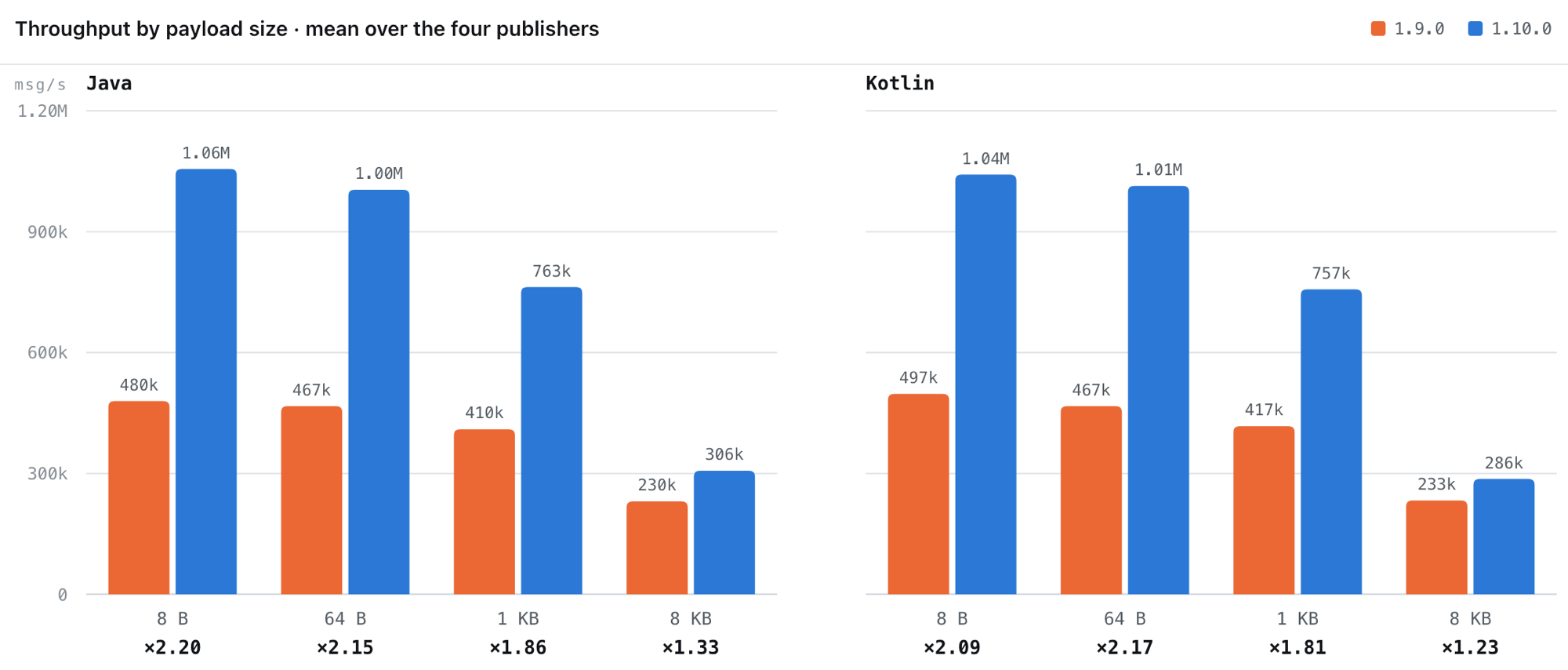
Several minor but breaking API changes were introduced with this update:
Timestampis now a Zenoh type, and it exposes the ID of the node that produced the timestamp. This piece of information was lost before.SampleMisswas renamed toMissto match the Zenoh API.
In addition, the accept-replies API was stabilized, and the build now uses the Gradle wrapper.
Zenoh-TS
The Nuxt example shipped with Zenoh-TS was extended to exercise a much larger part of the API, making it a more useful starting point for web applications than a minimal pub/sub demo.
Zenoh-Pico
Improved connection establishment
Zenoh-Pico now makes session startup more resilient when configured listeners or peers are not immediately available. Applications can configure z_open() to retry failed listen and connect operations for a bounded period or indefinitely, instead of failing after a single attempt. Separate exit-on-failure settings allow applications to choose between strict startup requirements and best-effort connectivity.
Client-mode connect endpoints are treated as alternatives, allowing the session to open as soon as one connection succeeds. In peer mode, Zenoh-Pico can establish the session through either a configured listener or a successful outbound connection. Once the session has a primary transport, it can continue attempting connections to additional peers when partial connectivity is permitted.
The new behavior is controlled by four configuration options:
Z_CONFIG_CONNECT_TIMEOUT_KEYcontrols how long failed connection attempts are retried.Z_CONFIG_CONNECT_EXIT_ON_FAILURE_KEYcontrols whether failed connections causez_open()to fail.Z_CONFIG_LISTEN_TIMEOUT_KEYcontrols how long opening the configured listener is retried.Z_CONFIG_LISTEN_EXIT_ON_FAILURE_KEYcontrols whether failure to open the listener causesz_open()to fail.
Timeouts are specified in milliseconds: "0" performs a single attempt, a positive value retries until the timeout expires, and "-1" retries indefinitely. The exit-on-failure options accept "true" or "false".
For example, a peer can retry listen and connect operations for ten seconds while tolerating individual failures:
z_owned_config_t config;
z_config_default(&config);

zp_config_insert(z_loan_mut(config), Z_CONFIG_LISTEN_TIMEOUT_KEY, "10000");
zp_config_insert(z_loan_mut(config), Z_CONFIG_LISTEN_EXIT_ON_FAILURE_KEY, "false");
zp_config_insert(z_loan_mut(config), Z_CONFIG_CONNECT_TIMEOUT_KEY, "10000");
zp_config_insert(z_loan_mut(config), Z_CONFIG_CONNECT_EXIT_ON_FAILURE_KEY, "false");

z_owned_session_t session;
z_result_t ret = z_open(&session, z_move(config), NULL);
A primary transport must still be established before z_open() can succeed. In particular, client mode always requires at least one configured connect endpoint to succeed.
These configuration options are currently available only when Z_FEATURE_UNSTABLE_API is enabled.
Idle read task and pending work reporting
A new build-time configuration variable, Z_RUNTIME_IDLE_READ_TASK_SLEEP (default 0), puts the Zenoh-Pico background read task to sleep for the given number of milliseconds when the last read returned nothing, instead of staying awake and polling sockets continuously.
This is mostly of interest in single-threaded mode, where the transport RX buffers are populated manually. There, zp_spin_once now reports whether Zenoh-Pico still has immediate work to do—accepting a pending connection, sending a keep-alive, or attempting a socket read—or whether spinning the executor again is pointless until the RX buffer is refilled.
Changelogs
The full changelog for every Zenoh repository is available at the following links:
Rust | C | C++ | Python | Java | Kotlin | TypeScript | Pico | DDS plugin | ROS2 plugin | MQTT plugin | WebServer plugin | Filesystem backend | RocksDB backend | S3 backend | InfluxDB backend
Zenoh 1.10.x Mucalinda is a release about the parts of the system you normally do not see. Nothing here changes how you write a publisher or a subscriber, but the bytes now leave the kernel faster on Linux, the JVM bindings stop paying a JNI tax on every field, and when something is slower than you expect, the message itself can tell you which hop cost you the time.
Taken together with the smaller changes—waiting instead of polling for the transport SHM provider, bounding advanced-subscriber state, choosing what shared memory is used for, and installing Zenoh-Python straight from apt—this is a release that should mostly make itself felt by getting out of your way.
As always, your feedback, contributions, and real-world deployment stories help shape the future of Zenoh. Join the conversation, share your experiences, and help us continue making Zenoh better for everyone.
You can reach us on Zenoh’s Discord server!
– The Zenoh Team